
Scott Kahan: The Sky is Falling, Expect Another Santa Clause Rally

Scott Kahan: The Sky is Falling, Expect Another Santa Clause Rally
Scott Kahan, Certified Financial Planner ™ professional and President of Financial Asset Management Corp. in Chappaqua and NYC, discusses how to drown out conflicting economic narratives from your investment decisions.
One day I read that the sky is falling, the next day I’m told to expect another Santa Clause rally… what gives?
 Both could be true. We could have a stock market correction and a rally between now and the end of the year. Let’s look at daily market closes this year. The S&P 500 closed at 5868 on January 2 and hit its Q1 peak of 6144 on February 19. Donald Trump announced his tariff regimen on April 2 and by April 8, the S&P 500 dropped to 4982. That’s a 20% drop. Ten weeks later the market gained it all back and surpassed its previous 2025 high. Yesterday it closed at 6878.
The sky fell and then the sky rallied…
Yes, the best and worst of today’s market predictions can be true, and usually prove to be, when played out over time. If we could all see the future, we would know which prediction would bear out first and we could all make a killing in the market—coming and going. But we can’t. The lesson is don’t make investment decisions based on TV talking heads, opinion writers, or prognosticators.
Your clients must ask you the same questions…
We are having exactly these kinds of discussions now and have been all year. I tell them to separate their emotions from politics or market fluctuations from their investment decision.
Got back to the model…
Yes. We have a model we use with all our clients. It begins with setting financial goals long, short and intermediate and developing a financial plan to achieve them. The core of that plan, after setting aside cash for an emergency fund is developing an asset allocation strategy and then sticking to it.
Can you describe that for us?
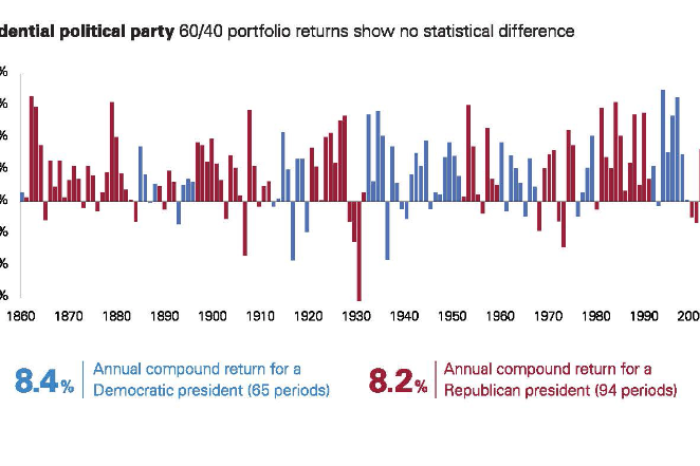
We have many model portfolios our clients use but the one most referenced amongst financial planners is the 60/40 portfolio. This is comprised of 60% equities and 40% fixed income which includes bonds and cash equivalents such as CDs, money market funds and Treasury Bills. As markets fluctuate the performance of side of your portfolio usually exceeds that of the other because stocks and bonds tend to perform inversely. When your asset allocation strays too far from your plan, say equities now are 65 or 70% of your portfolio—you sell stocks and buy bonds or move your profits into cash equivalents to restore your 60/40 desired balance.
How does this help resolve the sky is falling—no its isn’t?

To answer that, let’s return to our predicate that we can’t predict the future. Therefore, we don’t know which prediction will bear out. If you stick to your plan and let your portfolio tell you what to do instead of market sentiment you eliminate the fear that things are going well but may not continue so it’s time to bail out. As well, as the gamblers instinct, that we all have, that things are going well so let’s let it ride. Or even change our allocations so we can grab more upside of one asset class or another.
What do you do if your allocations are on track, but you seem to be underperforming the market?
That’s where diversification becomes so important. And here I mean diversification within asset classes. Historically the stock market is lead at times by value stocks and at other times by growth stocks. If you are not holding growth stocks when they are driving the market, then your portfolio will underperform the market. This year is a particularly strong year for international stocks that are up 30% in our client’s portfolios. We set asset allocations for value stocks, growth stocks, small caps, international and emerging market stocks within our portfolios. This allows us to rebalance within the equity class and take profits from one group to reallocate them to another.
Without having a crystal ball
That’s right. Let’s take another example of how two conflicting narratives can both be right.
You mean, are we experiencing an AI Bubble or just the beginning of a long-term boom
 That’s right. There’s no way to know without a crystal ball. Parts of the market look a bit frothy but one can’t help but feel like this is another paradigm shift in our economy like the industrial revolution of the 1920s or the personal computer of the 1970s. The truth is our greatest fear about our current technology market and our greatest hopes about it may both be true. The AI stocks could experience a major correction and at some point, probably will. Ten years from now our highest hopes may prove to be naively low.
It would be great to bail out before the correction and go back in for the long haul after that, wouldn’t it?
Yeah. But what if you’re wrong and you can’t get back in? That’s why you let your portfolio guide you. We don’t have AI allocations per se to adjust. Or even technology. But these types of stocks are reflected in the ETF’s and funds we hold in our growth assets. When they run up out of balance, we adjust. When they lag, we can reallocate into them from other asset categories that are outperforming them.
Set some goals. Have a plan. Stick to it.
That’s how you take the emotions and the second guessing out of investment decisions.
Financial Asset Management Corporation has provided fee-only financial planning and investment management services for individuals and small businesses in the Tri-State area since 1986. They serve 175 clients and manage over 400 million dollars in assets. (26 South Greeley Avenue, Chappaqua, NY, (914) 238-8900; www.famcorporation.com )
More on What To Do from Scott Kahan here:
You may also like